
Oldies but goldies: Ivan’s Childhood (1962)

Director: Andrei Tarkovsky; Main Cast: Nikolay Burlyaev, Valentin Zubkov, Evgeniy Zharikov, Stepan Krylov, Nikolay Grinko;
Tarkovsky’s first feature film is a rather bleak account of the final year of World War II on the Russian front. The main point of view is not a soldier but a 12-year-old boy, Ivan (Burlyaev), whose life has been ravaged by the German invasion. We find Ivan working as a military scout, infiltrating behind enemy lines and then reporting back information on Nazi positions and movements. He is collected by a sentry after a long swim across a river and delivered to young Lieutenant Galtsev (Zharikov), who, at first, doesn’t believe him to be a scout, being just a boy. Galtsev discovers that Ivan has been taken under the wing by Captain Kholin (Zubkov), his subaltern Katasonov (Krylov) and also his superior Lt. Colonel Gryaznov (Grinko), all of whom would love nothing more than to send him away to safety to a military school. Unfortunately Ivan is hell-bent on revenge against the Nazis and wants only to be part of the war effort, either with the army or with the partisans. Kholin and Gryaznov can only accept his stubbornness and plan the next recon mission, across the same river, in preparation for the Russian offensive. Ivan is carried on a dinghy by Kholin and Galtsev, with the favor of the night and some luck, and then left on the German shore to proceed on his own. It will be the last time Kholin and Galtsey will see him. The film then moves on to the end of the war and the epilogue of the story, seen through Galtsev’s eyes. Tarkosky’s inspired shots and Vadim Yudov’s cinematography perfectly depict the grimness of the life on the front, juxtaposing it with peaceful and beautiful scenery (I’ve never seen a birch wood so enchanting!). The contrast between Ivan’s dreams and his present life is also rendered very well, and I appreciated water as recurring element in both, maybe symbol of connection and, at the same time, separation. Although not for light entertainment, this film is captivating and original, I would say that, along with Battleground, it is the most candid representation of events during World War II, without any glamour or over the top heroics. Unrelenting and gripping —8/10
This post is my contribution to the Russia in classic films blogathon, hosted by Fritzi at Movies Silently. You can read all the other entries here:

Filed under Oldies but goldies, Seen at home
Até que a Sbórnia nos Separe

Directors: Otto Guerra, Ennio Torresan; Main Cast: Hique Gomez, Nico Nicolaiewsky, Otto Guerra;
An old man (Guerra) tells the story of his childhood in idyllic Sbornia, small peninsula separated from the rest of the world by a huge wall. He reminisces about the simple way of life with its quirks and peculiarities of his birthplace, about his father Kraunos (Gomez) and his good friend Pletskaya (Nicolaiewsky), both appreciated musicians that enlivened the evenings of the town. Besides the love for music and merriment, Sbornians have a penchant for drinking bizuwin, a beverage made with a local, slightly psychotropic plant, and axe ball, a rather unusual sport halfway between rugby and hand-pelota. The bucolic life of Sbornia is disrupted on a fateful day when the wall collapses due to an accident and the modern customs and different social mores of the outside world are brought to Sbornia. Pletskaya and Kraunos observe the reactions of their countrymen and showcase the different attitudes: while some quickly adopt foreign culture as Pletskaya, others prefer to reaffirm the Sbornian traditions and resist imperialism much like Kraunos. The latter witnesses, with increasing dismay, the dramatic changes without being able to prevent the inevitable doom. To complicate matters, Pletskaya falls in love with Coqueliquot, daughter of the magnate that is industrialising Sbornia to produce a soda flavoured with bizuwin. The film is based on the play “Tangos & Tragédias” and it is an insightful picture of social and economical changes in a small community with plenty of humour and amazing music. The authors of the play, Nico Nicolaiewsky and Hique Gomez, have also wrote and composed most of this movie’s great songs and happens to be the voices of the main characters. The animation and the drawing style are distinctive and appealing, the story has a good pace and it’s very entertaining. Lively —8/10
Filed under Animation, Seen at the cinema
Il Capitale Umano
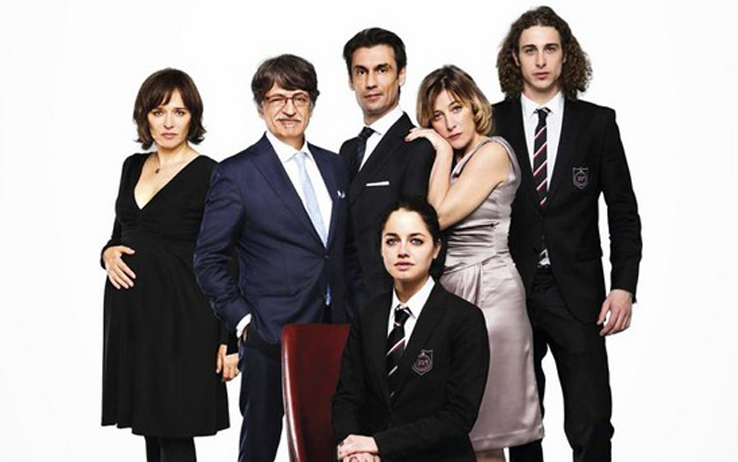
Director: Paolo Virzì; Main Cast: Fabrizio Bentivoglio, Matilde Gioli, Valeria Bruni Tedeschi, Guglielmo Pinelli, Fabrizio Gifuni, Valeria Golino, Luigi Lo Cascio;
Stark and unapologetic portrayal of Italian middle and upper class through the story of two families: the Ossola and the Bernaschi, their fortunes collide after a terrible accident on a night before Christmas. The film has a Rashomon’s structure with: a short prologue showing a cyclist being run off the road by a dark SUV late at night, the previous six months leading to the night in question told by the point of view of three characters and an epilogue. Firstly the audience meets Dino Ossola (Bentivoglio), he is a small time real estate agent, his business is in crisis but he wants to make the big bucks no matter what. As it happens his teenager daughter Serena (Gioli) and Massimiliano Bernaschi (Pinelli) both attends a posh private school and are dating, perfect way for Dino to insinuate himself into the life of powerful financial banker Giovanni Bernaschi (Gifuni) and get involved in high risk but highly rewarding investments. He lies and cheats to try and get what he wants, not caring that he’s risking his children’s future. As time goes by and the financial crisis tightens its grip, things start to look grim for Dino and the ones closest to him are none the wiser: his second wife is too involved with her work as psychologist for troubled kids and his daughter has her own problems to deal with. Cue to Carla Bernaschi (Bruni Tedeschi), once an actress, she married up and lives now a cushy life among the well-to-dos, busing herself with shopping. Her life seems rather aimless until she finds a new interest: save the local theatre from being converted into condos. After getting the money from her husband, she organises the renovation and put together an artistic committee that will manage the activities of the theatre. Carla pours herself into the work and makes a tight connection with Donato (Lo Cascio) since Giovanni is too busy and worried about his business and her son too self-absorbed. The last charter is Serena’s point of view, it sheds light on a few tricky details of the story and makes it all clear about what really happens the night of the accident. I don’t want to give away the ending so I’ll just say that she ends up being the strongest character, more determined and selfless than the rest. Although adapted from a an American novel, Paolo Virzi manages to give a scary picture of the opulent and self-serving upper-middle class that lives in the small towns north of Milan, with a sharp eyes for details and social nuances. The film keeps the viewer engaged and interested to the very end, however it does leave a bitter aftertaste and a gloomy outlook of Italy nowadays, perfectly exemplified by Carla’s last line: “You bet on the downfall of this country and you won”. The cast is spectacular: from Fabrizio Bentivoglio’s rendering of Dino, unctuous, mellifluous and down right repellent to Valeria Bruni Tedeschi’s pitch perfect interpretation of Carla, so lackadaisical and passive but ready to do what is necessary even if it’s despicable. Special mention to Matilde Gioli, her Serena is impressive and very relatable. Provocative and compelling —9/10
Filed under Seen at the cinema
Bosch (season 1)

Main Cast: Titus Welliver, Jamie Hector, Amy Aquino, Lance Reddick, Annie Wersching;
I’ve decided to watch Bosch because of Titus Welliver, finally someone had the guts to give him a chance as lead actor after decades of solid work as character actor in many TV-shows and a few films (most viewers will remember him as “the man in black” from Lost but to me he will always be War, the horseman, from Supernatural and Jimmy O from Sons of Anarchy). The show is co-created and co-written by Michael Connelly, based on his successful (apparently) series of books. I’ve never read the books so I cannot judge on the quality of the source material but the on-screen version works well, with a vibe halfway between Southland and a Michael Mann’s movie. Set in Los Angeles, Harry Bosch is a homicide detective in the Hollywood division with a reputation for being tough, not following the rules but always getting the job done (seriously?!?). In addition our hero has a tormented past (war vet and traumatic childhood), a difficult love life, he’s a loner, a workaholic and a distant father. What can I say: all the boxes for the most used cliches about detectives are checked so let’s move on, nothing new here. What really works is Welliver’s performance, he makes the character believable and, as a viewer, you can’t help but root for him. It also doesn’t hurt to have two The Wire alumni among the main cast: Jamie Hector as Jerry Edgar, Bosch’s partner, Lance Reddick as Deputy Chief Irving. Both actors do their best but, unfortunately, their characters have little depth and are mostly one-dimensional. Fans of The Wire might cringe a bit thinking that Lt. Daniels has metamorphosed into Deputy Rawls, all politics and no real police work, but hey that’s life (if you have not seen The Wire, you should definitely do that before even thinking of watching Bosch!). Amy Aquino is Bosch’s direct superior, Lt. Billets, smart, tenacious but also a good friend. Luckily she has a more well-rounded role and it’s a fair depiction of a woman in a tough line of work. Same goes for Wershing’s rookie cop: pushy and go getter, who champs at the bit and can’t wait to be a detective. She also happens to be Bosch’s love interest that, naturally, will complicate his life even more. The two intertwined story lines of a cold case and a serial killer on a rampage keep you interested and mildly invested and I liked the photography and some of the directing choices. So all in all a honest, quality cop show without thrills or innovative approach. Reliable —6/10
Filed under TV-shows
Relatos Salvajes

Director: Damián Szifrón; Main Cast: Darío Grandinetti, María Marull, Ricardo Darín, Leonardo Sbaraglia, Oscar Martínez, Erica Rivas, Diego Gentile, Julieta Zylberberg, Rita Cortese;
Damian Szifron wrote and directed this multi-segmented film that explores the dark and wild side of human nature. Each of the six episodes starts from a very simple premise: a plane trip, a new customer at a truck-stop restaurant, an overtaking on the motorway, a car towed away, a hit-and-run accident and a wedding celebration; each story however evolves into something far more extreme than usual with a morbid humour and, in a few cases, very grim endings. The common denominator is always the loss of control, the refusal to be logical or sensible while facing the facts and just giving in to a more visceral and primal reaction. The first two stories are strictly about vengeance: long and carefully planned like the count of Montecristo or more in the spur of the moment like Beatrice Kiddo in Kill Bill (and equally bloody); both episodes are told with a slow pace and a mounting sense of foreboding. The fourth and fifth tales are more about “the insolence of office, and the spurns
that patient merit of th’ unworthy takes“, the former taking a very extreme turn reminding me of Michael Douglas’s character in Falling Down. The third and the sixth episodes are centered on what can happen if you cross the wrong person and how things might escalate (very quickly!) into violence. It is not a surprise that Pedro Almodovar is the producer since the mood and the flair of this film strongly remind of his early dark comedies (e.g.¡Átame!), he probably recognised the genius and the potential of these grim but very entertaining parables. The whole cast is quite brilliant but a special mention should go to Erica Rivas for her role as deranged bride. I must say that when the film ended I was surprised, I would have watched at least another hour of these tales of ordinary folly. Impressive and riveting. —8.5/10
Filed under Seen at the cinema

The Satellite Girl And Milk Cow

Director: Hyeong-yoon Jang; Main Cast: Yu-mi Jeong, Ah In Yoo;
This film follows the much used formula of boy-meets-girl but in a very unusual way. Meet Il-ho (Yu-mi Jeong): lonely, de-commissioned satellite who falls to Earth after hearing a song by a street musician and it’s transformed into a girl robot (reminding me a little of Nana Supergirl) by a close encounter with a monster-incinerator. Meet Kyung-chun (Ah In Yoo): hapless composer and musician of said song, heartbroken, after being dumped by his longtime girlfriend, and transformed into a milk cow. If being a milk cow and not a boy anymore wasn’t enough, Kyung-chun’s life is in danger from two horrible foes. First off, there’s a nasty teleporting bounty hunter with a magical bathroom plunger, he removes organs from the bodies of brokenhearted humans turned into animals and he sells them to a black market dealer. Secondly, perhaps even worse, there is the above mentioned monster-incinerator who roams the streets of Seoul looking for the same type of prey but to drop them into his fiery, gluttonous mouth. Well, tough times indeed for being heartsick, like adding insult to injury or, maybe more aptly, injury to injury. Anyway, our unlucky musician is helped by Il-ho and by the great wizard Merlin, who happens to be a toilet paper roll (consequence of a curse), yep you read it right and, let me tell you, it is the best part of the movie. Naturally amor omnia vincit but the whole story is definitely unconventional and, at times, quite funny. My only complain is the soundtrack since I don’t find romantic pop songs in Korean my favorite cup of tea. The animation is top-notch and I’m looking forward to seeing more of Hyeong-voon Jang’s work in the future. Remarkable —7/10
Filed under Animation, Seen at the cinema
Mr Selfridge (season 1)

Main Cast: Jeremy Piven, Frances O’Connor, Aisling Loftus, Grégory Fitoussi, Trystan Gravelle, Amanda Abbington, Tom Goodman-Hill, Katherine Kelly, Samuel West, Zoë Tapper;
Harry Selfridge (Piven), visionary American tycoon, moves with his family to London in 1908, to open a high-end department store. Based on the book Shopping, Seduction & Mr Selfridge by Lindy Woodhead and written by Andrew Davis (Pride and Prejudice, Wives and Daughters among his works), it follows not only the struggles and successes of the titular character but it gives us insights on his employees, friends and family. Using a well-tested formula of upstair/downstair, we navigate through both high society and working class worlds, with a little dose of what goes on in between. As an outsider in the upper crust of London, Selfridge needs a sort of sponsor or patron to be accepted and, thanks to friend and journalist Frank Edwards (West), he finds just that in Lady Mae (Kelly). Her shrewd and calculated moves help Harry greatly and set him and his store on the path of success. What I found particularly interesting are his publicity stunts using the celebrities of the time (a pilot, an explorer, Arthur Conan Doyle, a renown ballerina) and his idea to enlist a famous showgirl, Ellen Love (Tapper) as “the spirit of Selfridge” (an ante litteram celebrity endorsement). As it can be foreseen from the beginning, matters will end up quite entangled between Ms Love and Mr Selfridge. Among Harry’s family, the focus is mostly on his wife Rose (O’Connor) who is reserved, sensible and with an independent streak that will lead to a surprise. On the employee front, the attention is on: the ingénue Agnes Towler (Loftus), shop girl with big dreams and a lot of determination; Henri Leclair (Fitoussi), French genius designer, who creates artful tableaux for the windows of the store; Victor Colleano (Gravelle), waiter with a talent for cooking; Mr Groove (Goodman-Hill), chief of staff and capable right hand of the boss, and Miss Mardle (Abbington), head of the accessory department who seems a little too controlled for her own good. At the beginning I found Piven’s performance a bit grating, even over the top, but then I realised it was just his take on the character when he finally started to show more nuances. I must say: kudos! Occasionally, however, I wished for a witty one-liner of the Dowager Countess of Grantham or a caustic comment from Lady Mary to jazz up a scene. Other times I ended up thinking: “Carson would find this rather unseemly”. Still, the story has a good pace and the cast works well. The costumes, the sets and the production design are splendid, they add indeed charm to each episode but at times they feel like one of Henri’s store windows: beautiful but distant. My overall impression is that Mr Selfridge is to Downton Abbey as Elizabeth Gaskell is to Jane Austen. Nonetheless a good fix for period drama withdrawal. Pleasant —6.5/10
Filed under TV-shows
Diplomatie

Director: Volker Schlöndorff; Main Cast: André Dussollier, Niels Arestrup, Burghart Klaußner, Robert Stadlober;
Cyril Gely adapted for the screen his play by the same title about a battle of wills between Dietrich von Choltitz (Arestrup), the German military governor of occupied Paris, and Swedish consul-general Raoul Nordling (Dussollier). The film takes place during the fateful night of the 24th of August 1944, after von Choltitz has received the order to reduce Paris to a pile of rubbles since the Allies are about to liberate it. Nordling shows up, rather unexpectedly, to the governor’s office and try to convince von Choltitz to disobey his orders. The two men know each other quite well and try to use it as an advantage in this bloodless confrontation. Of course we all know that Paris was never destroyed but it is still interesting to see Nordling pleading with von Choltitz, tellling him he will go down in history as the man who laid waste to a beautiful and emblematic city. On the other hand, the governor thinks he has no other choice, since Hitler has threatened the well-being of his family. It seems to me that diplomacy looks a lot like poker: you don’t play the cards you play the man. Although very static, it is still an engaging film, thanks to the brilliant performance of the two leads. I also like the use of original footage of the Allies entering Paris, not new but effective (and it probably saved some money on production!). It’s still an entertaining story even if it is not completely accurate from a historical point of view. Diverting —7/10
Filed under Seen at the cinema
Mr Turner

Director: Mike Leigh; Main Cast: Timothy Spall, Paul Jesson, Dorothy Atkinson, Marion Bailey;
Visually stunning biopic of J.M.W. Turner (Spall): dedicated, single-minded and inquisitive painter of the 19th century. Mike Leigh’s take on Turner is focused on the last twenty-five years of his life, when he’s already an established artist and master of the craft. Turner spends his time either travelling (abroad or in the country) or painting in his London’s home, which he shares with his beloved, aging father William (Jesson) and Hannah (Atkinson), faithful housekeeper who has feelings (not returned) for the painter. The film gives a dichotomous portrayal: on one hand the genius of the light rendered on canvas, on the other the eccentric, at time cantankerous, man with a rather complex personal life. We witness Turner’s determined study of light in any condition of time and weather, even going to extreme measures like being tied up to the mast of a ship to observe a snow storm at sea. Both celebrated and reviled by public and critics (including royalty), he is popular among his fellow artists of the Royal Academy, although considered peculiar as shown in a couple of quite effective scenes. During one of his trips to the seaside, he befriends a local landlady, Ms Booth (Bailey), with whom he eventually lives in secret in Chelsea until his death. Mike Leigh manages to balance well the dichotomy in Turner’s life and describes skillfully this man, who grew up in the bohemian world of Covent Garden, but was later held accountable by the more rigid Victorian moral standards. Timothy Spall really owns the role, giving an intense and convincing performance and injecting some humanity in a character that could come across as too cold and detached. Special kudos also to Dorothy Atkinson for her Hannah. Powerful —8/10
Filed under Seen at the cinema

The World’s End
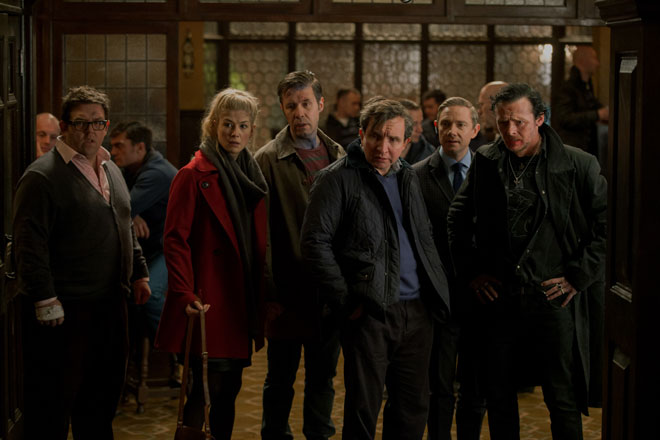
Director: Edgar Wright; Main Cast: Simon Pegg, Nick Frost, Martin Freeman, Paddy Considine, Rosamund Pike, Eddie Marsan;
The Big Chill meets Invasion of the Body Snatchers seasoned with British humour. It sounds good on paper, I know, especially considering that it’s written by Simon Pegg and Edgar Wright (and directed by the latter), who already gave us Shaun of the Dead and Hot Fuzz. Unfortunately, this film was not at the same level: the true funny moments are too few and far apart. Gary (Pegg), a recovering addict, wants to recapture the magic of the glory days when he was young and free, only seventeen. In order to do that he needs to give another try to the epic pub crawl (12 pints in 12 pubs!) that he and his old gang never finished. Unlike Gary, Andy (Frost), Oliver (Freeman), Steven (Considine) and Peter (Marsan) have managed to grow up and not just grow taller. They all have jobs and quite fulfilled lives but Gary convinces, coerces and outright lies to his friends to get them back to their hometown (in a very Jack-and-Elwood way). So the boys are back in town, not really enthusiastic about it but going through the motion to appease the unstoppable Gary. The first surprise is a mundane although pleasant one: Oliver’s sister, Sam (Pike), is also there, just a token love interest or a way to prove even more that Gary is a jerk? Not clear. Anyway, after this, our heroes begin to notice something strange is going on in their beloved town… the people around them are not exactly people! Gary, Andy and the rest realise that their evening out is much more they bargained for. They have to fight for their life and reach the last pub: The World’s End (foreshadowing ?). Unfortunately this mad race is not as fun to watch as it probably was to shoot for the actors. I did like Billy Nighy’s cameo though! Disappointing . — 5.5/10
Filed under Seen at home
Il Giovane Favoloso
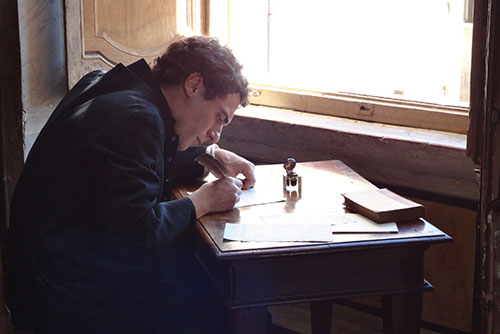
Director: Mario Martone; Main Cast: Elio Germano, Michele Riondino, Massimo Popolizio, Isabella Ragonese, Anna Mouglalis, Edoardo Natoli, Valerio Binasco;
The life and struggles of Giacomo Leopardi, Italian poet and philosopher of the early 19th century. We follow Giacomo (Germano) from his early, intense studies in his childhood’s home in Recanati, under the tutelage of priests and rigidly supervised by his father Montaldo (Popolizio), reactionary and narrow minded, to the time he spent in Florence, Rome and Naples, where he met (and established few life-long friendships) with historians, classicists, poets and intellectuals. His youth in Recanati, although plagued by both physical and emotional ailments, is sweetened by the presence of his younger siblings Carlo (Natoli) and Paolina (Ragonese), playmates and allies who lighten the burden of suffocating and controlling parents. The fire of rebellion is ignited by the visit of Pietro Giordano (Binasco), a classicist, with whom Giacomo has been exchanging letters over the years, keeping alive their friendship and fruitful collaboration. After a failed attempt to escape his stifling, oppressing home, it will take Giacomo a few more years to finally be free to roam the world (well, just Italy, as it turns out). The story moves then to the final years of Giacomo’s life. We find him in Florence, living with his good friend Antonio Ranieri (Riondino), writer and free-thinker exiled from his native Naples for his political views. Antonio is quite the opposite of Giacomo: charming and outgoing, at ease in social gatherings and with the ladies. Giacomo’s inner pain and his deteriorating health are the roots of his pessimistic view of the world that set him apart from his contemporaries. He is criticised and shunned by other intellectuals, not only in Florence but also in Rome and Naples, where the two friends moved, in an attempt at finding a more suitable environment for the fragile poet. One flaw of the film is the lack of details about the complex political situation in Italy at the time, which was entwined with the literary world and a key element in Leopardi’s life. Throughout the film there are explicit and implicit references to his poems and other writings which, although very beautiful, might not be fully appreciated by viewers unfamiliar with his work. Elio Germano gives a spellbinding performance as the sickly but brilliant poet and Michele Riondino is quite effective as the roguishly charming but loyal friend. The sure hand of Mario Martone at the helm, the supporting cast, the beautiful photography and production design contribute as well to make this film a little gem. Enchanting —7.5/10
Filed under Seen at the cinema








 Ramblings of a cinephile